
What Are the Benefits of Outdoor Playgrounds for Preschoolers?

Preschoolers are built to move. They have high energy levels, they are not going to play silently for several hours, and they definitely won’t learn the best by staying indoors. They require space. Fresh air. Room for running, climbing, falling, getting back up, and trying again.
Thus, outdoor playgrounds are of great importance during this period of development.
At Jolly Roger Land, we are always observing how children interact with each other and how their interaction through play develops them. Movement, either inside or outside, alters everything for young children. And when it comes to a playground for preschoolers, outdoor spaces provide a different kind of development that is difficult to imitate.
Outdoor Play Is the Early Start of Building Stronger Bodies
Preschoolers are still learning the mechanics of their bodies. Running, jumping, climbing, hanging, and balancing are all part of the process.
Kids are encouraged by outdoor playgrounds to be physically active and use their entire bodies at the same time. Different levels, ladders, monkey bars, slides, and open space are all part of the playful activity. These things build muscle strength, coordination, and balance in a way that flat indoor floors just don’t.
A proper playground for children aged three to five doesn’t require expensive gadgetry. The main requirements are space for physical activities and obstacles that are not too difficult to conquer. Children's self-esteem is increased each time they accomplish something new without anyone's help.
We experience it very often. One day, they hesitate. The next day, they climb without thinking.
Confidence Grows Outside
Outdoor play has a way of letting kids lead. There’s no set path. No rules telling them where to go next. They decide.
That freedom builds confidence fast.
Preschoolers learn how to take small risks. How to judge height. How to try again after slipping. These are real-life skills, not just play skills.
Outdoor playgrounds give kids space to make decisions without adults stepping in every second. And that matters. Confidence doesn’t come from being protected all the time. It comes from learning what you can handle.
Social Skills Develop Naturally
Put a group of preschoolers on an outdoor playground and watch what happens. They figure things out together.
Who goes first? Who waits. Who wants to play together? Who needs space.
These interactions aren’t forced. They happen naturally when kids share open space. The unstructured nature of outdoor play promotes cooperation, communication, and problem-solving among children.
The child's first experiences with group interaction are generally at the playground, where kids open up to each other in very simple and straightforward ways. In fact, during nap time, it is not uncommon to have kids arguing for the coveted spot near the teacher!
The Nature Play Enhances Attention and Regulation of the Capacity to Act
Outdoor-play-loving preschoolers usually appear to be more attentive afterward. They’re calmer. Less restless. More open to listening.
Movement helps release energy. Fresh air helps regulate mood. Outdoor play gives kids a reset.
We hear parents say it all the time. After play, their child eats better, naps better, and listens better. That’s not a coincidence.
Even families who live near a play center in San Jose often tell us they look for outdoor playground time before or after indoor play. The combination works.
Imagination Has More Room Outside
Outdoor spaces don’t tell kids what to pretend. A structure can be a castle one minute and a spaceship the next.
Preschoolers use what’s around them to build stories. Sticks become tools. Slides become mountains. Open space becomes anything they want.
Outdoor play feeds creativity without screens, without instructions, without pressure. Children can invent their own amusement, and this is an ability that should be preserved.
Nature Contact Is More Important Than We Realized
Grass. Dirt. Sun. Wind.
All these minor things are ways for the children to interact with their environment. Playing in the open shows the kids the textures, sounds, and feelings that the closed spaces can’t give them.
Toddlers who are often in the open air are more curious and less moody by nature. They get used to various surroundings right from their childhood.
Even families who visit a play center in San Jose for indoor play often look for outdoor time as part of their routine. Balance matters.
Outdoor Play Fosters Self-Reliance
Outdoor playgrounds tend to be less structured compared to indoor areas. This is a good feature.
Kids decide the place they want to be, the duration of their stay, and when to change the spot. They acquire self-sufficiency skills unwittingly.
Preschoolers learn to trust themselves. To listen to their bodies. To recognize when they’re tired or ready for something new.
That independence carries over into everyday life. Dressing themselves. Speaking up. Trying new things.
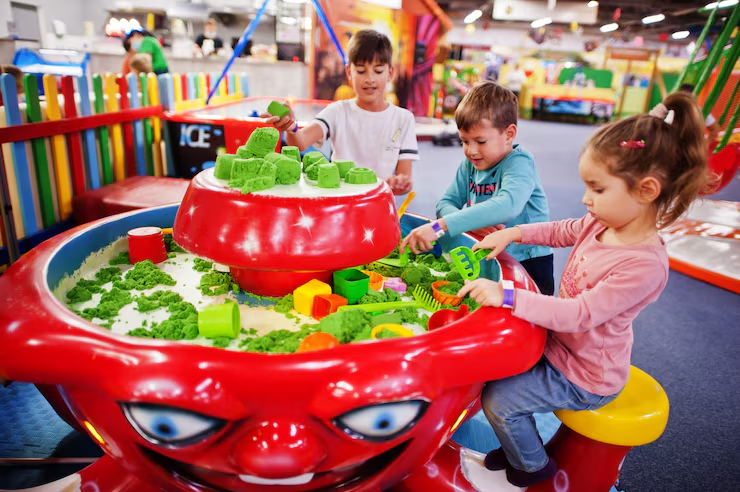
Why Indoor and Outdoor Play Both Matter to Us
At Jolly Roger Land, we believe play should match where kids are developmentally. Young children require both kinds of experiences: indoor and outdoor.
Safety, consistency, and comfort come from indoor play, while challenge, exploration, and freedom are provided by outdoor play.
It is quite common for families to schedule visits to indoor facilities along with outdoor playground time. This way, children are kept active, and burnout is avoided.
Whether you are going to a play center in San Jose or your local park, the purpose is the same. Let children move. Let them discover. Let them develop.
Conclusion
Playgrounds for outdoor children are not simply a means of killing time; they are a basis.
They assist the little ones in developing physically, mentally, and socially, all at the same time. They allow children to experience defeat without any danger, and to enjoy victory with pride.
With proper playgrounds catered to the preschool age group, growth will happen in the same way as it would with the help of worksheets or screens.
Every day at Jolly Roger Land, we witness the activity's significance, whether it is inside or outside. Children's character is determined by play, and the preschool years are when that very foundation is laid.
Give them room. Give them moments. Let them play.
FAQs
1. What age group benefits most from outdoor playgrounds?
Preschoolers aged three to five years reap the largest benefits as a result of fast physical and social development.
2. Are outdoor playgrounds secure for children?
Yes, provided the equipment is suitable for their age and is closely monitored by adults.
3. How often should 3-5-year-olds be outside?
Every day is ideal, even if just for a little while; it will still have a profound impact.
4. Are indoor and outdoor aspects of the child’s play compatible?
Definitely, mixing the two modalities ensures equilibrium and prolongs children's interest.


Comments